
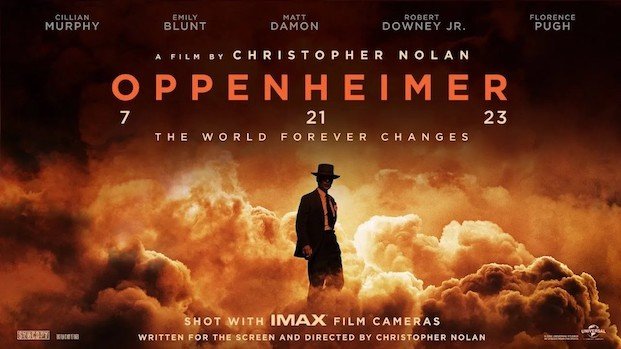
Oppenheimer (2023), directed by Christopher Nolan, is a dense and gripping biographical drama that examines the life of J. Robert Oppenheimer and the creation of the atomic bomb. Rather than focusing solely on spectacle, the film leans heavily into character, ethics, and the long shadow cast by scientific ambition. It’s less a traditional war film and more an intense psychological and political study.
Cillian Murphy delivers a commanding performance as Oppenheimer, portraying him as brilliant, conflicted, and increasingly haunted by the consequences of his work. His quiet intensity anchors the film, while strong supporting performances—particularly from Robert Downey Jr. and Emily Blunt—add depth and tension. The cast as a whole elevates the material, making long dialogue-heavy scenes feel urgent and purposeful.
Visually, Oppenheimer is striking, even when it’s largely driven by conversation rather than action. Nolan’s use of practical effects, sound design, and a relentless score creates an atmosphere of constant pressure. The film’s nonlinear structure mirrors Oppenheimer’s fractured inner world, though this approach may be challenging for some viewers.
That said, the movie demands full attention. Its rapid pacing, overlapping timelines, and heavy emphasis on political hearings and scientific debate can feel overwhelming. This is not a casual watch, and viewers looking for a straightforward narrative may struggle.
Overall, Oppenheimer is a bold, intellectually demanding film that rewards patience. It’s an unflinching look at responsibility, power, and the moral cost of progress—one of the most serious and thought-provoking films in recent years.