
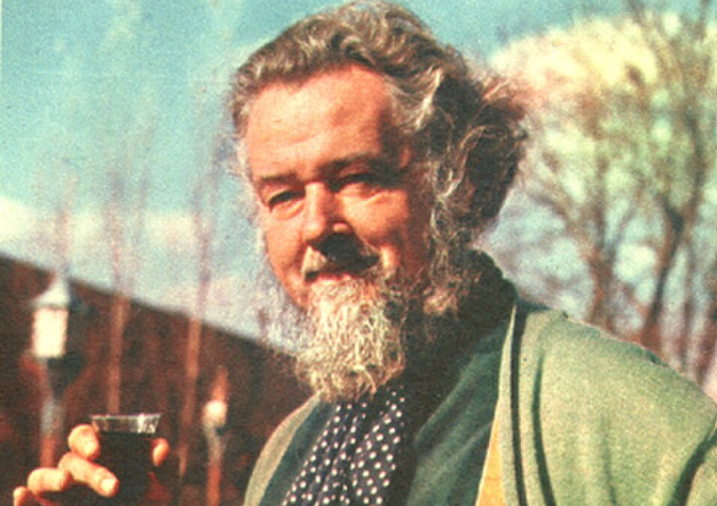
Today marks the birthday of Richard Sedlon (August 26, 1900), one of Bedford’s most beloved artists and perhaps its most imaginative resident. While many remember his paintings and whimsical “Pooka” characters, fewer know about the remarkable fantasy garden he once created behind the historic Dunham House.
Sedlon spent nearly his entire life in Bedford after moving here as an infant. His artistic talent emerged at an early age, eventually leading him to study at what is now the Cleveland Institute of Art. Throughout his career, he became known not only as a painter, but also as a lithographer, sculptor, poet, philosopher, gardener, and teacher.
His artwork often blended local landscapes with mythology and fantasy. Around 1970, he introduced the “Pookas,” peaceful woodland creatures that lived in an imagined society devoted to art, music, reading, and nature. Sedlon affectionately referred to himself as the “Pooka Elder.”
After marrying Anne Nyerges in 1950, the couple lived for many years in Bedford’s historic Hezekiah Dunham House. There, Sedlon transformed the backyard into what visitors described as a fantasy garden. Wooden carvings, hand-painted signs, sculptures of Pookas and mythical creatures, whimsical birdhouses, and carefully tended gardens turned the space into a work of art all its own. Friends gathered there to talk about art while enjoying Sedlon’s homemade wine, and wild birds became regular guests, often eating from his hand.
Although the garden disappeared after Sedlon’s passing in 1992, its spirit lives on through photographs and memories. Today, visitors to the Dunham House can view a recreation of Sedlon’s studio on the second floor, preserving a glimpse into the life of the artist whose imagination helped shape Bedford’s cultural history.
As Bedford celebrates what would have been Richard Sedlon’s birthday, it’s worth remembering that some of the city’s greatest works of art weren’t confined to a gallery. One of them bloomed quietly in a backyard, where creativity, nature, and community came together in a way that reflected the artist himself.