
Ten years after Bedford stopped Point-of-Sale inspections, homeownership is up, home prices have nearly tripled and the old POS rules are still sitting in the city’s ordinances.
The snapshot:
- 2001 – POS implemented, 2016 – POS stopped
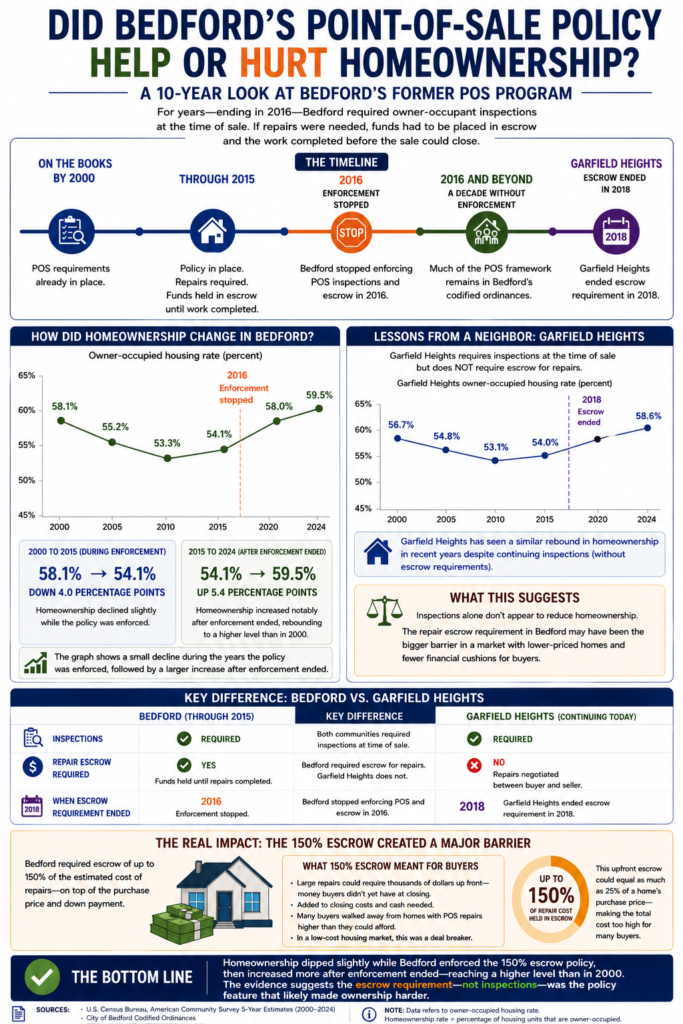
- 60% → 50% → 59%: Bedford’s owner-occupancy rate from the 2001 to 2016 to today.
- 184 → 257: Residential sales from 2016 to 2017 — a nearly 40% jump in one year.
- $55,100 → ~$165,000: Bedford’s median home sale price from 2016 to today.
- 150%: The repair escrow Bedford could require under one section of its POS code.
- 10 years: How long Bedford has gone without enforcing POS – even though much of the law remains in its codified ordinances.
Why it matters: Bedford’s housing market clearly improved after POS enforcement stopped in 2016. The numbers suggest a strong case that forced inspections of homes was a mistake.They make a stronger case against requiring thousands of dollars in repair escrow in a city of inexpensive homes.
The Big Picture: Ten years ago, Bedford stopped enforcing its Point-Of-Sale housing inspection program. Before a home could change hands, the city required an inspection. If code violations were found, Bedford could also require money to be placed in escrow to guarantee repairs. This program was lauded by Bedford government and Council as being a way to keep the houses in Bedford maintained and improve property values. But now that we can look back on 10 years of data, did this controversial program hurt or help Bedford?
The program effectively ended in May 2016, after a federal judge blocked Bedford from conducting warrantless point-of-sale inspections. Bedford froze the inspections, and they never resumed. But Point-Of-Sale never entirely disappeared. Ten years later, provisions governing the inspections and repair escrow remain in Bedford’s ordinances, even though the city no longer enforces the program. *
Meanwhile, Bedford’s housing market has changed considerably. Only about half of Bedford’s occupied homes were owner-occupied around the early 2010s. Today, that figure is close to 60%. Home sales also jumped immediately after enforcement stopped, from 184 in 2016 to 257 in 2017 — an increase of nearly 40%. So did ending Point-Of-Sale help bring homeowners back?
The evidence suggests the answer may depend on which part of the policy we mean.
A tale of two cities
Garfield Heights offers a useful comparison. Bedford had Point-of-Sale by at least 2000. Garfield Heights adopted a similar program in 2001. Both inspected home interiors, and both historically included repair escrow.
Both also lost homeowners.
In 2000, about 60% of Bedford’s occupied homes were owner-occupied, compared with nearly 80% in Garfield Heights. By 2010, Bedford had fallen to about 56%, while Garfield Heights had fallen to about 73%. By the early 2010s, Bedford was around 50% and Garfield Heights about 71%.
The foreclosure crisis played a major role in those declines, so point of sale cannot be blamed for them.
Around 2016, however, the cities took different paths. Bedford stopped POS inspections altogether. Garfield Heights kept inspecting homes but stopped routinely requiring repair escrow. Today, Bedford is about 59% owner-occupied. Garfield Heights is about 58.5%.
| Year | Bedford | Garfield Heights | Policy context |
| 2000 – 2001 | 60% | 79.90% | Bedford & Garfiled put POS + escrow in place |
| 2010 | 55.80% | 73.20% | Both operating with POS + escrow |
| 2016 | 50% | 70.7% (2013) | Bedford ends POS; Garfield retains POS but retains escrow |
| 2024 | 59% | 58.50% | Bedford has no POS, Garfield has POS with no escrow |
This doesn’t prove Point-of-Sale or related escrow determined what happened in either city. This all did happen during the aftermath of the 2008 housing crisis. But it does make a compelling case that the policy, especially the escrow, was likely more harmful than helpful.
Bedford’s former escrow requirement could be substantial. In 2016, the median Bedford residential sale price was about $55,100. The city’s former POS system included provisions requiring as much as 150% of estimated repair costs to be placed in escrow.
On a median-priced Bedford home, $2,500 in repairs could require $3,750 in escrow — 6.8% of the sale price. With $5,000 in repairs, the escrow could reach $7,500, or 13.6%. And $10,000 in repairs could require $15,000 — more than 27% of the home’s sale price.
These figures show how large the requirement could become in a low-cost housing market.
Other communities have questioned that burden too. Maple Heights continues POS inspections but waives escrow for qualifying owner-occupant buyers specifically to reduce barriers to homeownership. Buyers must still correct the violations.
Research from the Federal Reserve Bank of Cleveland also found little evidence that POS ordinances produced their intended neighborhood-stabilization benefits. POS programs with escrow were associated with higher property-tax delinquency in portions of the analysis, although researchers cautioned that the findings did not prove the policies caused those outcomes.
Bedford’s housing market clearly improved after POS enforcement ended. Its median sale price rose from about $55,100 in 2016 to $73,279 in 2018, while homeownership eventually returned to nearly 60% and median sale price is $164,901.
Given the numbers, the Point-Of-Sale program likely did harm. The question is why are the mechanics of this failed policy still on the law books? Is this a policy that Bedford City Council is considering reviving or is City Council simply too complacent to clean up after their own failed policies?
——————————————————————————————
*§ 1311.18 — Certificate to Be Furnished by Seller
(a) No person shall sell or enter into an agreement to sell or convey by land contract or otherwise, any interest in any dwelling, building or structure as defined in the Zoning Code without furnishing the buyer, prior to such sale, a current Certificate of Inspection setting forth the authorized use of the dwelling, building or structure under the ordinances of the city and listing any code violations; and, when code violations still remain outstanding at the time of delivery of possession or transfer of title, an escrow shall be established, and there shall be deposited in that escrow both a statement from the buyer acknowledging receipt of the Certificate and an amount of money equal to 100% of the value of the work required to bring into compliance with city ordinances and codes all outstanding violations, performance bond, or an amount authorized by the City Manager & the Building Commissioner.
However, a statement signed by both the seller and the buyer stating that the premises are undeveloped and contain no dwelling, building or structure may be deposited in escrow in lieu of documents and/or funds required herein.
(b) It shall be unlawful for the owner of any real estate premises to transfer legal or equitable ownership of that premises (“title”) without having obtained a pre-sale inspection of it under this code.
This inspection will enable the code official to work toward accomplishing the purposes of this code by listing any repairs or other work necessary to eliminate any unsafe or hazardous conditions, to comply with applicable requirements of the Building Code, Fire Code, Zoning Code and other ordinances, and also to correct any unlawful nuisance conditions in the form of violations of this Property Maintenance Code.
Such an inspection and list shall be part of the process of issuing the required certificate of occupancy.
§ 1311.20 — Seller; Notice to Division of Building
Any person acting in the capacity of real estate agent or broker or otherwise assisting buyers and sellers in real estate transactions shall notify the Bedford Division of Building when a parcel of land containing a dwelling, building or structure has been listed with such person, firm, or corporation for sale.
Such notice shall be filed in writing with five (5) days of such listing and shall contain the address of the property, the name and address of the owner and the nature of the present use thereof.
§ 1311.21 — Issuance of the Certificate of Inspection
This is the section containing Bedford’s actual POS inspection standards. It says the Building Department is to conduct a general inspection that includes conditions inside the dwelling, including basement conditions, plumbing, stairs, smoke detectors, doors and windows, and electrical systems. It also specifies exterior/property-maintenance items including gutters, masonry, siding, sidewalks and drives, roofing, vegetation and painted surfaces.
If corrections cannot be made by the seller prior to the transfer of the title, an escrow account shall be established, into which an amount of money shall be placed equal to one hundred fifty percent (150%) of the value of the uncompleted repairs or corrections. This amount shall be established by procuring at least one estimate from a company capable of performing the work and which is currently registered to work in the City of Bedford.
These funds shall be disbursed only after verification from the Building Official that the work is complete. While all estimates must be reviewed by the Bedford Building Department for completeness and adequacy prior to the transfer of title, the Building Department assumes no responsibility that the amount of money held in escrow will be sufficient to finance the necessary corrections.
When it is determined by the Division of Building that a dwelling, building or structure is in compliance with the provisions of these Codified Ordinances and all other applicable rules and regulations applicable thereto, the Building Official shall issue a Certificate of Point of Sale Compliance for the premises.