

Bedford has been planning for aging infrastructure for years — but residents still can’t easily see what comes next.
Why it matters: Roads, water lines, sewers and traffic systems eventually need major repair or replacement. In an older, largely built-out city, those costs can become a major long-term financial challenge.
The Big Picture: As Bedford’s roads, water lines and sewers get older, one question becomes increasingly important: Is the city planning for their eventual replacement, or simply fixing things as problems arise?
The answer is more reassuring than it may appear from the city’s website.
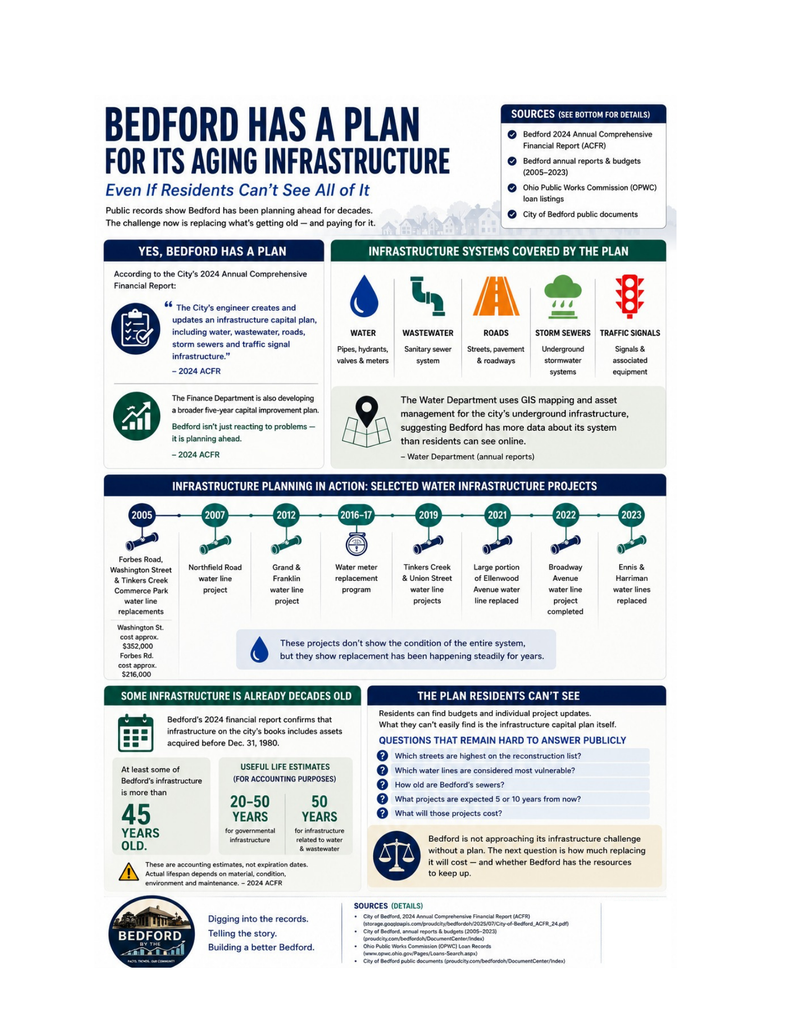
According to Bedford’s 2024 Annual Comprehensive Financial Report, the city engineer “creates and updates an infrastructure capital plan” covering water, wastewater, roads, storm sewers and traffic signals. The Finance Department is also developing a broader five-year capital improvement plan. In other words, Bedford does have a system for looking ahead.
Planning goes back decades
This isn’t new.
City financial records show Bedford had a five-year capital plan as far back as 2005, when the city described it as a tool for addressing infrastructure and facility needs. That year, Bedford reported replacing water lines on Forbes Road, Washington Street and in Tinkers Creek Commerce Park. The Washington Street project cost approximately $352,000 and Forbes Road about $216,000.
Other documented projects followed: Northfield Road in 2007, Grand and Franklin in 2012, a water-meter replacement program in 2016 and 2017, and water-line work on Tinkers Creek and Union Street.
More recently, Bedford replaced a large portion of the Ellenwood Avenue water line in 2021, completed the Broadway Avenue water-line project in 2022 and replaced lines on Ennis and Harriman in 2023.
Those projects don’t tell us the condition of the entire system, but they show infrastructure replacement has been happening steadily for years.
Some infrastructure is already decades old
Bedford’s 2024 financial report confirms that infrastructure currently on the city’s books includes assets acquired before Dec. 31, 1980. That means at least some of Bedford’s infrastructure is more than 45 years old. How much is that old — or considerably older — isn’t clear from publicly available information.
For accounting purposes, Bedford estimates useful lives of 20 to 50 years for governmental infrastructure and 50 years for infrastructure associated with operations such as water and wastewater.
Those aren’t expiration dates. Infrastructure can last substantially longer or fail sooner depending on its material, condition and maintenance. But they demonstrate why planning for replacement matters in an older community.
The Water Department also says it uses GIS mapping and asset management for the city’s underground pipes, hydrants, valves and meters, suggesting Bedford has considerably more information about its system than residents can see online.
The plan residents can’t see
That’s the biggest missing piece.
Residents can find individual project announcements, annual budgets and financial reports. What they can’t easily find is the infrastructure capital plan itself.
That makes some basic questions difficult to answer publicly: Which streets are highest on the reconstruction list? Which water lines are considered most vulnerable? How old are Bedford’s sewers? What projects are expected five or 10 years from now? And what will they cost?
The city engineer’s infrastructure plan may answer many of those questions. It simply isn’t readily available to residents. For much of the 20th century, Bedford’s infrastructure challenge was building the streets, water lines and sewers needed for a growing suburb. Today’s challenge is different.
Bedford is largely built out. Increasingly, the city must maintain and replace the infrastructure previous generations left behind — without gaining new houses or taxpayers simply by replacing an old pipe or rebuilding an existing road. The good news is Bedford isn’t approaching that challenge without a plan.
The next question is how much replacing all of it will eventually cost… and whether Bedford has the resources to keep up.
This week’s Do You Know Bedford? answer: Bedford Glens.