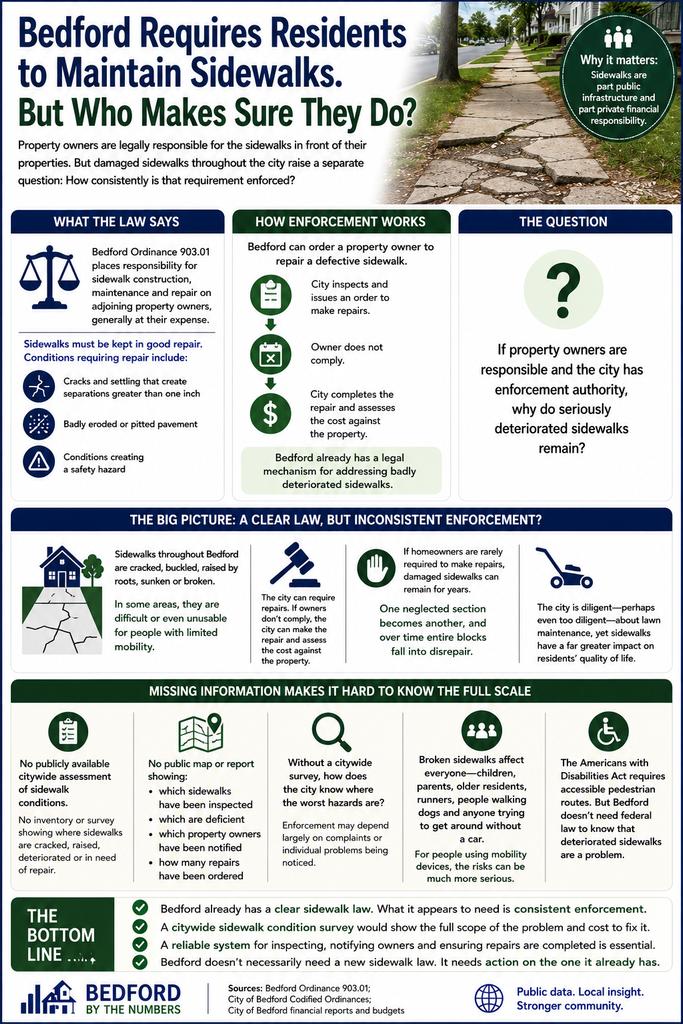

Bedford property owners are legally responsible for maintaining the sidewalks in front of their properties. But damaged sidewalks throughout the city raise a separate question: How consistently is that requirement enforced?
Why it matters: Bedford’s sidewalk system is part public infrastructure and part private financial responsibility. The sidewalks are available for public use, but city law generally places the cost of maintaining them on the adjoining property owner.
What the law says: Bedford Ordinance 903.01 places responsibility for sidewalk construction, maintenance and repair on adjoining property owners, generally at their expense. The city’s property-maintenance rules also require sidewalks to remain in good repair.
Among the conditions requiring repair are:
- cracks and settling that create separations greater than one inch
- badly eroded or pitted pavement
- conditions creating a safety hazard
How enforcement works: Bedford can order a property owner to repair a defective sidewalk. If the owner does not comply, the city has the authority to complete the repair and assess the cost against the property. That means Bedford already has a legal mechanism for addressing badly deteriorated sidewalk sections.
The question: If property owners are responsible and the city has enforcement authority, why do seriously deteriorated sidewalks remain?
The big picture: Bedford’s sidewalk ordinance is clear: property owners are responsible for maintaining and repairing the sidewalks in front of their homes. The condition of many sidewalks throughout the city suggests that requirement is not being consistently enforced.
Across Bedford, sidewalks can be found cracked, buckled, raised by tree roots, sunken or broken into uneven sections. In some areas, years of deterioration have left stretches of sidewalk difficult to navigate and, for people with limited mobility, sometimes unusable.
Under Bedford Ordinance 903.01, homeowners are responsible for the construction, maintenance and repair of the sidewalks that front their properties. In most cases, those repairs are also made at the homeowner’s expense.
Bedford’s property maintenance code is even more specific. The code requires sidewalks to be maintained in good repair. It says sidewalk sections with a height difference of more than one inch caused by cracking or settling must be repaired or replaced. Sidewalks that are badly eroded or deteriorated enough to create a pedestrian safety hazard must also be repaired.
The city also has the authority to require property owners to make repairs. If an owner fails to do so, Bedford can have the work completed and assess the cost against the property.
In other words, Bedford already has a system for dealing with unsafe sidewalks. The question is how often that system is actually being used?
If homeowners are responsible for sidewalk repairs but are rarely required to make them, damaged sidewalks can remain in place for years. Individual property owners have little reason to repair the sidewalks around their property without enforcement. Over time, this has resulted in Bedford’s sidewalks to decline significantly. One neglected section becomes another, and over time entire blocks fall into disrepair.
This lack of sidewalk maintenance enforcement is surprising as the City is diligent, perhaps even too diligent, about lawn maintenance when arguably the conditions of the sidewalks have a larger impact on a resident’s quality of life than if their neighbor’s lawn is an inch or two too long.
How can residents know if they should replace their sidewalk?
Another concern is that there does not appear to be a publicly available citywide assessment of Bedford’s sidewalk conditions. A search of publicly available city records and information did not locate a sidewalk inventory or condition survey identifying where sidewalks are cracked, raised, deteriorated or otherwise in need of repair.
There also does not appear to be a publicly available map or report showing which sidewalks have been inspected, which have been found deficient, which property owners have been notified or how many repairs have been ordered. That makes it difficult to know the full scale of the problem.
It also raises a basic question: If the city has not systematically surveyed its sidewalks, how does it know where the worst hazards are? Without a citywide assessment, enforcement may depend largely on complaints or individual problems being noticed rather than on a broader plan.
Who does the broken sidewalks affect?
That matters because sidewalks are shared public spaces. Broken sidewalks affect children walking to school, parents pushing strollers, older residents, runners, people walking dogs and anyone trying to travel through a neighborhood without a car.
For people who use wheelchairs, walkers or other mobility devices, the consequences can be much more serious. A raised or broken slab that a pedestrian can step over may be impossible for someone using a mobility device to cross safely.
The Americans with Disabilities Act adds another layer to the issue because cities have responsibilities to provide access to public programs and pedestrian routes. But Bedford does not need federal law to recognize that deteriorated sidewalks are a problem. Its own ordinances already require them to be maintained.
Shouldn’t we expect our city to maintain sidewalks?
The larger issue is whether Bedford is inspecting sidewalks, identifying hazards and consistently enforcing the rules already on the books. If property owners are going to remain responsible for repairs, the city needs a reliable system for inspecting sidewalks, notifying owners and making sure needed work is completed. A citywide sidewalk condition survey would also give Bedford a clear picture of where the worst problems are and what it would take to bring the sidewalk network back into good repair.
Bedford does not necessarily need a new sidewalk law. It already has one. What it appears to need is a clear assessment of sidewalk conditions and consistent enforcement of the law already in place.