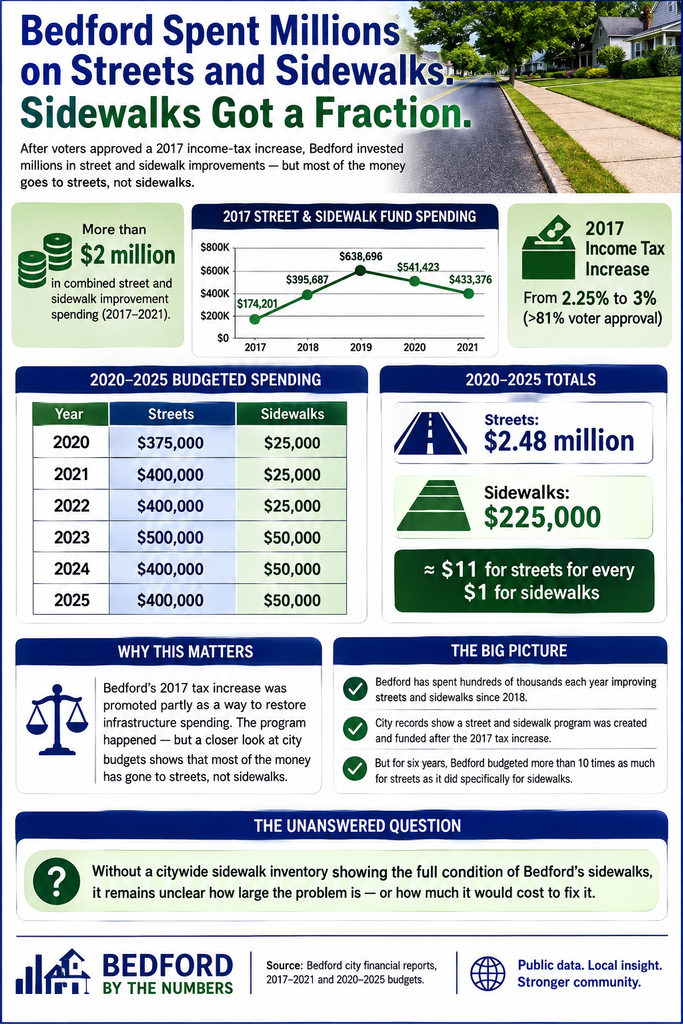

Bedford did follow through on a promise to restart street and sidewalk improvements after voters approved a city income-tax increase in 2017. But city budgets show streets received far more money than sidewalks.
Why it matters: Bedford’s 2017 tax increase was promoted partly as a way to restore infrastructure spending after the city had gone years without a regular street and sidewalk improvement program. The program happened. The question is how much of it actually went toward sidewalks.
By the numbers: Bedford’s annual financial reports show combined spending from the Street and Sidewalk Improvement Fund reached:
- 2017 — $174,201
- 2018 — $395,687
- 2019 — $638,696
- 2020 — $541,423
- 2021 — $433,376
That is more than $2 million in combined street and sidewalk improvement spending over those five years.
Zoom in: Bedford’s budgets show that most of the money was directed toward streets.
From 2020 through 2025, budgeted spending included:
Year Streets Sidewalks
2020 $375,000 $25,000
2021 $400,000 $25,000
2022 $400,000 $25,000
2023 $500,000 $50,000
2024 $400,000 $50,000
2025 $400,000 $50,000
Over those six years, Bedford budgeted about $2.48 million for streets and $225,000 specifically for sidewalks.
That works out to roughly $11 for streets for every $1 designated for sidewalks.
The big picture: When Bedford voters approved an income tax increase in 2017, city officials said part of the new money would support a street resurfacing and sidewalk program. The program did happen. City records show Bedford has spent hundreds of thousands of dollars each year improving streets and sidewalks since the higher tax took effect in 2018. But a closer look at city budgets shows that most of the money has gone to streets, not sidewalks.
Bedford increased its income tax from 2.25% to 3% after voters approved the change in May 2017. More than 81% of voters supported the increase.
City financial reports said the additional money would allow Bedford to hire three police officers and create a street resurfacing and sidewalk program totaling about $400,000 per year. The city followed through on creating that program.
Bedford spent about $396,000 on street and sidewalk improvements in 2018. Spending increased to about $639,000 in 2019, $541,000 in 2020 and $433,000 in 2021, according to city financial reports. Those figures show the city was putting real money into the program. But Bedford’s budgets show a large difference between what was set aside for streets and what was set aside specifically for sidewalks.
In 2020, Bedford budgeted $375,000 for street improvements and just $25,000 for sidewalks. The sidewalk budget remained at $25,000 in both 2021 and 2022, while $400,000 was budgeted for streets each year. In 2023, the city increased sidewalk funding to $50,000. That year, it budgeted $500,000 for street improvements. The sidewalk budget remained at $50,000 in 2024 and 2025, while Bedford budgeted $400,000 each year for streets.
From 2020 through 2025, Bedford budgeted about $2.48 million for street improvements. During the same six years, it budgeted about $225,000 specifically for sidewalks. That means Bedford budgeted roughly $11 for street improvements for every $1 set aside specifically for sidewalks.
There may be good reasons for spending more on streets. Streets are expensive to repair and carry thousands of vehicles each day. Some sidewalk work may also be included in larger road or construction projects and paid for from other funds.
But the difference raises questions because Bedford’s sidewalks are also an important part of the city’s transportation system. Many sidewalks throughout Bedford are cracked, buckled, raised or badly deteriorated. Bedford law generally makes property owners responsible for maintaining and repairing the sidewalks in front of their homes. The city can order property owners to make repairs when sidewalks do not meet city standards.
The city has also assessed sidewalks as part of its annual repair program. In 2020, City Manager Mike Mallis said engineers reviewed Bedford’s streets and sidewalks each spring and selected areas where repairs were most needed. There is also evidence that specific sidewalk sections had been selected for city repairs by 2019.
However, no publicly available citywide sidewalk inventory has been found showing the condition of Bedford’s entire sidewalk system, how many sidewalk sections need repair or what it would cost to bring the whole system into good condition. Nor were property owners made aware of the status of the sidewalks in front of their properties to see if they needed to replace them.
That is different from the yearly engineering reviews used to choose individual repair projects. A full sidewalk inventory could show residents and city officials the size of the overall problem and help determine how much money would be needed to address it. Without that information, it is difficult to know whether the $25,000 to $50,000 budgeted each year specifically for sidewalks was enough to make a meaningful difference.
Bedford itself has recently acknowledged that sidewalk funding is limited. A 2025 city planning study noted that the city has a limited budget available for sidewalk improvements. The records show Bedford did create and fund the street and sidewalk program described after the 2017 tax increase.
The question is not whether the program existed. It did. The question is whether sidewalks have received enough of that money.
For six years, Bedford budgeted more than 10 times as much for street improvements as it did specifically for sidewalks. Without a citywide inventory showing the full condition of Bedford’s sidewalks, it remains unclear how large the problem is or how much it would cost to fix it.