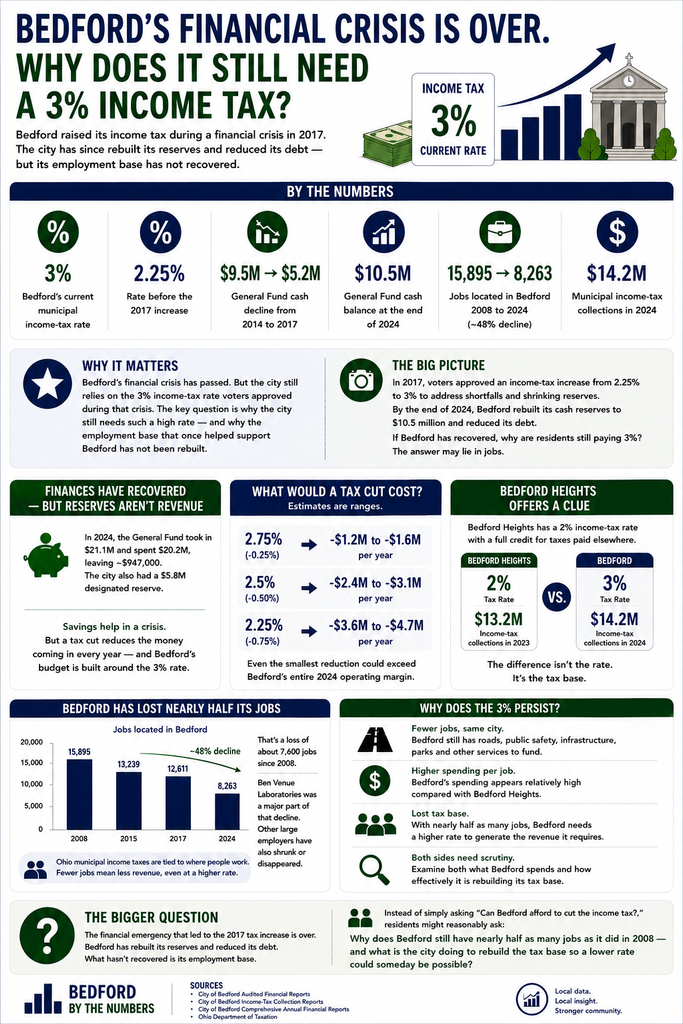

Bedford raised its income tax during a financial crisis in 2017. The city has since rebuilt its reserves and reduced its debt — but its employment base has not recovered.
By the numbers
3% — Bedford’s current municipal income-tax rate
2.25% — rate before the 2017 increase
$9.5M → $5.2M — General Fund cash decline from 2014 to 2017
$10.5M — General Fund cash balance at the end of 2024
15,895 → 8,263 — jobs located in Bedford, 2008 to 2024
~48% — decline in Bedford’s employment base
$14.2M — municipal income-tax collections in 2024
Why it matters
Bedford’s financial crisis has passed. But the city still relies on the 3% income-tax rate voters approved during that crisis. The question is no longer simply whether Bedford has recovered. It is why the city still needs such a high rate — and why the employment base that once helped support Bedford has not been rebuilt.
The Big Picture: In 2017, Bedford needed money. Major revenue losses and budget shortfalls were eating away at the city’s financial cushion. Bedford’s General Fund cash balance fell from about $9.5 million in 2014 to $5.2 million in 2017. Voters responded by approving an increase in Bedford’s income-tax rate from 2.25% to 3%.
It worked. By the end of 2024, the General Fund cash balance had climbed to about $10.5 million, higher than before the crisis. Bedford has also substantially reduced its debt.
That raises an obvious question: If Bedford has recovered, why are residents still paying 3%?
Part of the answer may have less to do with Bedford’s savings and more to do with something the city hasn’t recovered: jobs.
Bedford has recovered — but reserves aren’t revenue
In 2024, Bedford’s General Fund took in about $21.1 million and spent $20.2 million, leaving roughly $947,000 between the two. The city also had a $5.8 million designated General Fund reserve. That’s a much stronger position than Bedford faced before the tax increase.
But savings and annual income aren’t the same thing. A reserve can help a city through a temporary problem. A tax cut reduces the money coming in every year. And Bedford has built its current budget around the revenue produced by the 3% rate.
What would a tax cut cost?
Bedford collected about $14.2 million in municipal income tax in 2024.
Bedford By The Numbers modeled what might happen at lower rates. Because Bedford gives residents credit for municipal taxes paid where they work, the exact effect can’t be calculated from available public records. These estimates are ranges.
- A reduction to 2.75% could cost roughly $1.2 million to $1.6 million a year.
- At 2.5%, the estimated loss grows to about $2.4 million to $3.1 million.
- Returning to 2.25% could mean roughly $3.6 million to $4.7 million less each year.
Even the smallest estimated reduction could exceed Bedford’s entire 2024 General Fund operating margin. So a tax cut isn’t as simple as dipping into the city’s reserves.
But that leads to another question: Why does Bedford need such a high rate to generate enough revenue in the first place?
Bedford Heights offers a clue
Nearby Bedford Heights has a 2% income-tax rate and gives residents a full credit for municipal taxes paid elsewhere. Yet Bedford Heights collected about $13.2 million in income tax in 2023. Bedford collected about $14.2 million in 2024 — despite charging 3%.
The difference isn’t simply the tax rate. It’s the tax base.
Bedford has lost nearly half its jobs
Bedford’s own financial reports show a striking decline. In 2008, the city reported 15,895 jobs within Bedford. By 2015, there were 13,239. In 2017, 12,611. By 2024, Bedford reported just 8,263 jobs.
That’s a loss of about 7,600 jobs since 2008 — nearly half of the city’s employment base.
Ben Venue Laboratories was a major part of that decline. It employed nearly 1,500 people in 2012 before closing. Other large employers have also shrunk or disappeared from Bedford’s list of top employers. That matters because Ohio municipal income taxes are heavily tied to where people work.
A person doesn’t have to live in Bedford to help support Bedford’s government. Someone who drives into Bedford for work generally pays municipal income tax here. A strong employment base can therefore allow a city to raise substantial revenue without a particularly high tax rate. Bedford Heights demonstrates that.
But Ben Venue closed more than a decade ago
The loss of Ben Venue helps explain why Bedford needed the 2017 tax increase. It doesn’t fully answer why Bedford still has thousands fewer jobs today. More than a decade has passed since the company’s closure, yet Bedford’s reported employment base has continued to shrink rather than recover. That deserves more attention.
Economic development isn’t simple, and a city cannot order private employers to open businesses or create jobs. Regional economic changes, automation, mergers, remote work and decisions made by individual companies all matter.
But replacing lost economic activity is also one of the central purposes of local economic-development policy.
If Bedford’s 3% tax is now partly necessary because the city has fewer taxable jobs, residents have reason to ask not only why the tax can’t be reduced, but why the tax base hasn’t been rebuilt enough to make a reduction possible.
Fewer jobs, same city
Bedford hasn’t lost half its responsibilities just because it lost nearly half its employment base. It still has roads and infrastructure to maintain, police and fire departments to staff, parks and recreation facilities to operate and other services to provide. The General Fund also helps support public safety and capital improvements. That leaves fewer taxable jobs helping pay many of the same fixed costs. The 3% rate helps fill the gap.
Bedford’s governmental spending also appears relatively high compared with Bedford Heights, although differences in how the cities organize their finances make a simple comparison difficult.
That means both sides of the equation deserve scrutiny: what Bedford spends and how effectively it is rebuilding the revenue base that supports that spending.
The bigger question
The public numbers don’t show an easy path back to a 2.25% income tax. But they also don’t make 3% a question that should be considered settled forever. The financial emergency that led voters to approve the increase is over. Bedford has rebuilt its reserves and reduced its debt.
What hasn’t recovered is its employment base. That changes the question.
Instead of simply asking “Can Bedford afford to cut the income tax?”, residents might reasonably ask:
Why does Bedford still have nearly half as many jobs as it did in 2008 — and what is the city doing to rebuild the tax base so a lower rate could someday be possible?
Because if Bedford’s long-term answer to a smaller employment base is simply to maintain a higher tax rate, then the temporary financial crisis of 2017 may have produced a permanent solution to a problem Bedford still hasn’t solved.