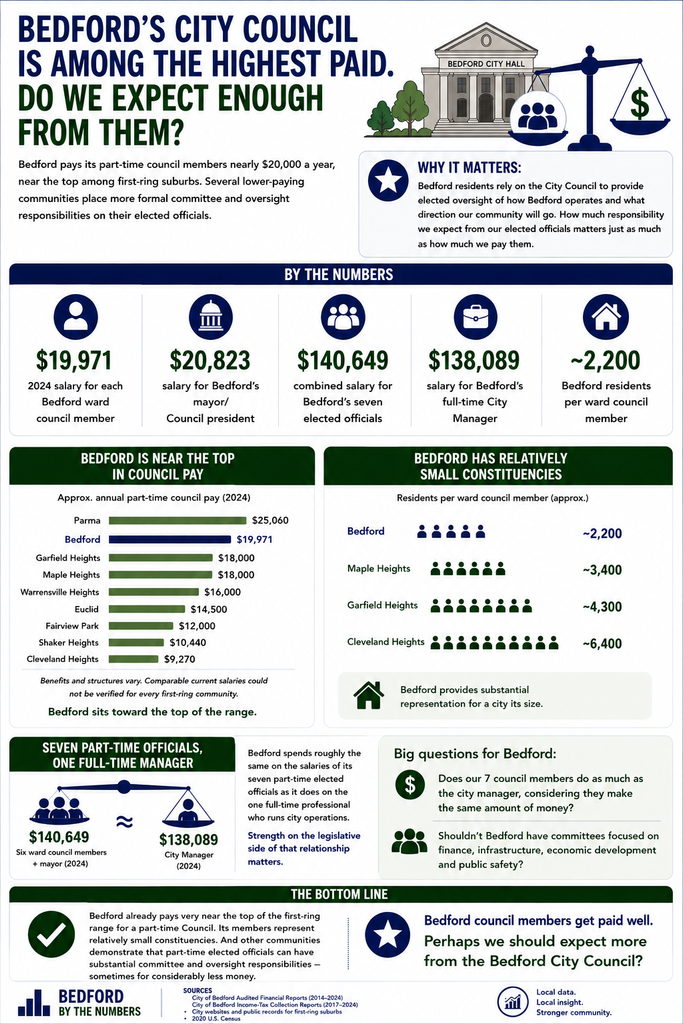

Bedford pays its part-time council members nearly $20,000 a year, near the top among first-ring suburbs. Several lower-paying communities place more formal committee and oversight responsibilities on their elected officials.
Why it matters: Bedford residents rely on the City Council to provide elected oversight of how Bedford operates and what direction our community will go. How much responsibility we expect from our elected officials matters just as much as how much we pay them.
By the numbers
- $19,971 — 2024 salary for each Bedford ward council member
- $20,823 — salary for Bedford’s mayor/Council president
- $140,649 — combined salary for Bedford’s seven elected officials
- $138,089 — salary for Bedford’s full-time City Manager
- ~2,200 — Bedford residents per ward council member
The Big Picture: Bedford City Council members are among the highest-paid part-time council members in Cuyahoga County’s first-ring suburbs. In 2024, each of Bedford’s six ward council members received about $19,971. Among first-ring communities where comparable salaries could be verified, only Parma paid ordinary council members more.
That raises a question:
Do we expect enough from the Council we’re already paying for?
Bedford is near the top in council pay
Here is how Bedford compares with several first-ring suburbs:
Community – Approx. annual part-time council pay
- Parma – $25,060
- Bedford – $19,971
- Garfield Heights – $18,000
- Maple Heights – $18,000
- Warrensville Heights – $16,000
- Euclid – $14,500
- Fairview Park – $12,000
- Shaker Heights – $10,440
- Cleveland Heights $9,270
Benefits and council structures vary, and comparable current salaries could not be verified for every first-ring community. But Bedford clearly sits toward the top of the range, not the bottom.
Why does Bedford pay nearly $20,000?
There is some history behind the salary. Bedford Council members once received city health insurance. During the city’s 2017 financial crisis, officials said health claims and administrative costs for six Council members had reached about $150,000. Bedford eliminated the benefit.
At the same time, officials discussed increasing compensation by roughly $600 per month per member, partly so council members could obtain insurance themselves. That helps explain Bedford’s relatively high salary today. But the additional compensation became salary, not an insurance reimbursement. Council members receive it regardless of how they obtain health coverage. And most other communities do not provide health insurance to their part-time council members.
Other part-time councils expect more structured work
Bedford Council does work outside its regular meetings. It holds work sessions and budget hearings, and that work should be counted. But some neighboring cities place more formal responsibilities on individual council members.
Bedford Heights uses standing committees covering finance, public safety, economic development, infrastructure, housing and public services. Its Finance Committee also serves as an Audit Committee.
Maple Heights requires council members to participate in assigned committees and Committee of the Whole meetings. Its rules can impose a $200 salary deduction for certain unexcused committee absences.
Cleveland Heights, where regular council members receive less than half Bedford’s salary, uses specialized committees and has held budget hearings with individual city departments.
These are all part-time councils. The difference is that individual members are formally assigned responsibility for becoming more involved in particular areas of city government.
Bedford does not currently have committees, does not have offices at City Hall and does not meet for any reason outside scheduled Council meetings and Budget meetings. In fact, some council members have been overheard to say they don’t even check their emails regularly.
Bedford has relatively small constituencies
Perhaps, Bedford council members might argue they are taking care of more residents per council person. But this is a fallacy. Bedford has substantial representation for a city its size.
The city had 13,149 residents in the 2020 Census and has six ward council members plus the mayor. That averages about 2,200 residents per ward representative.
By comparison, Maple Heights has about 3,400 residents per council member, Garfield Heights about 4,300, and Cleveland Heights about 6,400.
The systems aren’t identical, but Bedford council members aren’t representing unusually large constituencies. So what are they doing with their time beyond reporting on grass height infractions?
Seven part-time officials, one full-time manager
Another number puts Bedford’s Council spending into perspective. In 2024, Bedford paid its six ward council members and mayor approximately $140,649 combined. City Manager Michael Mallis received about $138,089.
Bedford therefore spent roughly the same amount on the salaries of its seven part-time elected officials as it did on the one full-time professional responsible for administering city government.
The jobs are different. The City Manager runs Bedford’s day-to-day operations. Council sets policy, approves spending, represents residents and provides elected oversight. But Bedford essentially spends a City Manager’s salary on each side of that relationship. That makes the strength of the legislative side important.
Does our 7 city council members do as much as the city manager, considering they make the same amount of money? Shouldn’t Bedford have committees focused on areas such as finance, infrastructure, economic development and public safety?
The bottom line
Bedford’s numbers don’t prove individual council members aren’t working hard. Constituent calls, preparation and research don’t necessarily appear in public meeting records. But right now, there is very little evidence that our highly paid council members do much beyond attending council meetings.
Bedford already pays very near the top of the First Ring Suburbs for a part-time Council. Its members represent relatively small constituencies. And other communities demonstrate that part-time elected officials can have substantial committee and oversight responsibilities — sometimes for considerably less money.
Bedford council members get paid well. Perhaps we should expect more from the Bedford City Council?