***Please be sure to read the bottom of this post***
If you went to Central Elementary in the 1970’s, there was no way to avoid Paul Patton. His out-of-the-office style drifted to the playground, where he trudged the muddy outfield in rubber galoshes, brown overcoat and a wool hat.
Abrupt broadcasts from the classroom’s PA speakers came to life with an echoing ‘Hey ya, hey ya, hey ya!’ rolling into an announcement, an advisement or a kind man’s warning.
What many of us didn’t know was the artful side to the man. If you were an active parent in the school, you might have received one of his deftly crafted pieces of pottery (as my mother did). A coffee mug perhaps, with a hook on the bottom of the handle, a pinky trap. Beautiful brownish bronze. Many of these glazed pieces came to be sold and quickly collected, identified by their “PP” at the bottom.
By the time my class left for Heskett at the end of the decade, Mr. Patton’s last stop was Aurora Elementary, shortly before retiring. At home, the kiln process with its ceaseless warm dust became too much for his growing emphysema. But in his heart, it was time to explore a boyhood theme of his own.
Rix Mills in Muskegon County was where his childhood memories lay. The difference for Patton was his town was strip-mined and had mostly vanished. He literally could not go home again.
So in a style that may have reached its commercial peak during this time, Patton began recalling scenes in what was commonly referred to as Folk Painting, sometimes American Primitive or as he referred to it, Memory Painting. Scenes of the town’s buildings and people in different seasons became his aesthetic, as were 4th of July scenes, church events and fairs.
From the late 1980s, Patton’s larger paintings began to gather acclaim and gallery attention throughout mid and northern Ohio.
As a growing art & architecture scholar, critic and collector, I had double interest in reconnecting with Mr. Patton. Acquire a painting for my own while securing an interview in my recent role at the Bedford Historical Society (I was an unpaid curator). Also, of course, to connect with a man who was easy to like.
I don’t remember the how of it, but in the Spring of 1996 I was invited to Paul and Dorothy’s home on Vine Street in Maple Heights. Their white 3-story on the street’s hill was filling with a growing number of acrylic ‘memories’. Dorothy admired him as the three of us sat and talked, it was easy to see. The floor favored the left side of the ground when I was asked to browse around their sitting room and ended up walking into his Moorehead Farm painting (recall Endora from “Bewitched” or the actress from Orson Welles’ Mercury Theater). The Moorehead family lived near the Pattons and the local families would occasionally have fires and roasts. Trees gathering at the top of the canvas serve as a green curtain to the fire-lit family scene beneath. It was the painting over which I immediately lingered and bought from him that day.
The Historical Society interview for which I came back a second time quickly became a question of why we didn’t organize and hang a show of his paintings in the Bedford area. If it was Patton’s intention to have a show I had no such feeling. But it wasn’t long after organizing the walking order of his paintings in my mind and thinking about a catalogue that I wondered if he was working on anything new.
Would he even consider creating a painting of Central School? This was different from his common subject matter over the years. But he did consider it. Another day, another conversation.
During our third visit he and I sat again in his living room, looking through each other and into the past. Patton thought about the school he ran. He liked the totem poles out front that were installed in the grass in the mid ‘70s. But it became apparent that the life of the school took place behind it, where you could also see the monstrous black fire escapes of the surrounded red 3-story 1905 building which lowered students onto a blacktop of four square, tetherball poles and the equipment layout which we recollected onto a piece of typing paper.
He smiled behind his wire rimmed glasses while we finished this discussion. Yes, it was something entirely new for him. Similar in style but a new direction. A more recent past without a dark ending.
Dick Squire, the Historical Society’s founder sat across from me in the dusk of the museum’s records room as we discussed the possibilities and the organizing of a Patton show.
It didn’t dawn on me then that it might have been difficult to give his nod to the newer library’s meeting room space, which was large, well lit and commanded more traffic. But it wasn’t affiliated with the museum in any way. The notion of using the Baptist Church, in my mind, which was the norm, would destine the show to darkness and likely less interest. How I won this point I have no recollection (most likely Dick’s kindness) but Cathy Cramer the library’s Branch Manager at the time saw the agreed upon show as a renewed opportunity to bridge the gap with the museum, as I did.
In May of 1996 the show’s string of paintings were hung in a single afternoon. “Paul Patton: Persistence and Memory” opened on a Saturday in the library’s large meeting room and ran for several weeks. I invited Plain Dealer critic Steven Litt and, brazenly, Robert Hughes (Just wanting to see if he would respond.. he did not). Copies of the catalog I wrote were left by the meeting room door for anyone to take who attended.
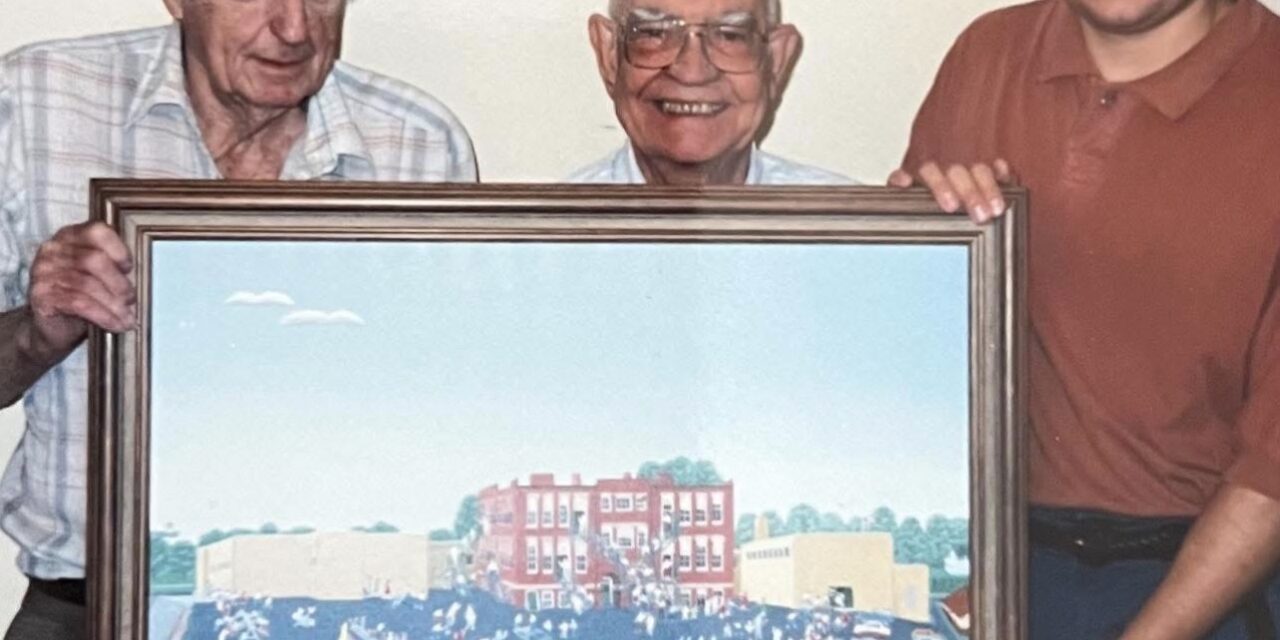
In the last spot of the show sat the newly completed Central School painting which depicted fewer than a handful of specific people, apart from Mr. Patton. At the top right door was, undoubtedly, Mr. Moenk.
Patton tied the entire school together, framing his trademark big sky composition with the teacher’s cars to the right and the old bus garage at left while still maintaining his original nod to the front side of the building with the cupola of a Victorian house on East Monroe Street, popping up at the left side of the canvas.
At the show’s opening gathering (which ran 2 hours or so) I counted almost 200 guests!
My purpose at the time was to further the knowledge (and market) for what Patton was hoping to achieve.
Being less observant, here’s what I totally overlooked and missed out on at the time. Within the turnout, a wonderful thing. Teachers from his era made it that afternoon, Dorothy Pliske, Betty Shishila (by then Grunau), and John Moenk, among others. They showed up in appreciation of the man and it would be the final time they gathered in one place, all getting some time and taking pictures.
I know this meant a great deal to him.
After the show ended, Mr. Patton gave permission to the Bedford Historical Society to run a series of prints of the Central School painting for fund raising purposes. These were to be numbered and signed. Bedford Lithograph produced the run.
What I did not anticipate was that he immediately gave possession of the original painting directly to the museum. As if this weren’t enough, he personally gifted me an 18 x 24
“4th of July,” painting that I mused was less chromatic than all the others. A ‘late night version,’ which I loved.
Within 3 years, Mr. Patton would be gone but his example of original ways of going about one’s work and passions thereafter remain with me.
***30 years later, on April 15th, 2026, the Bedford Historical Society suffered an unexpected blow as hail storms ripped through our hometown. All northwest windows of both the museum and church were damaged and are currently boarded. The Historical Society is forced into assessing repairs.
One way you can help: prints of Central School from the original 1996 printing have been found and can once again be purchased.
These should become popular as plans are being made to tear down various buildings in the district, and possibly Central itself.
Please contact Lauri Schroeder or Betsy Lee at the Bedford Museum to have one of your own. ***