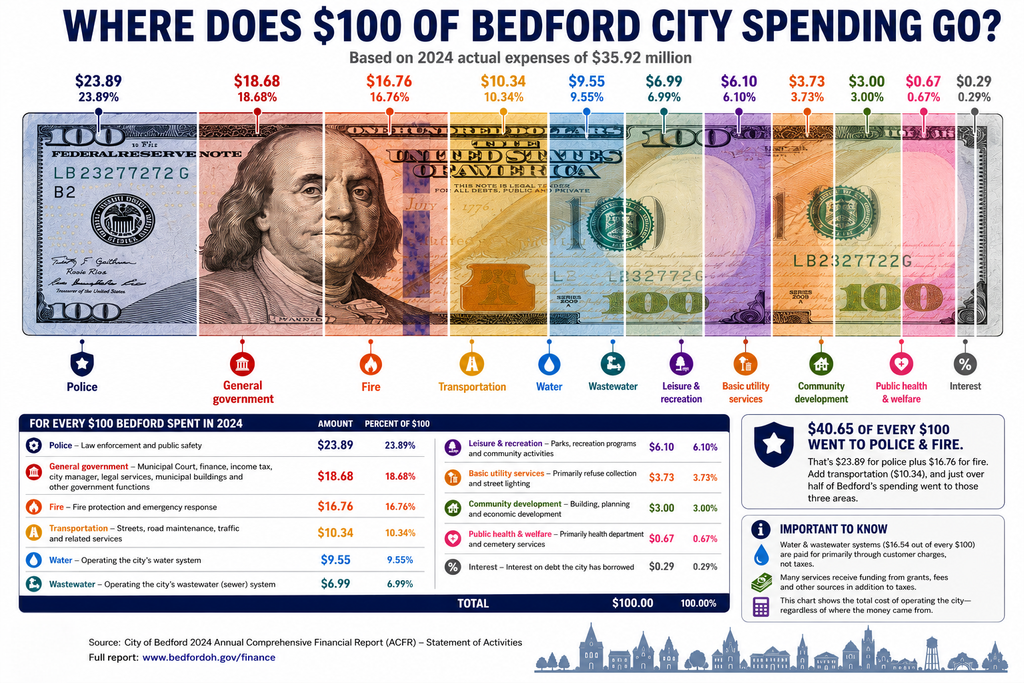

If all of Bedford’s city spending in 2024 were reduced to a $100 bill, nearly $41 would have gone to police and fire. Another $19 would have paid for general government functions, about $10 would have gone toward transportation, and roughly $17 would have operated the city’s water and wastewater systems.
In all, the City of Bedford reported about $35.9 million in expenses in 2024, according to its most recent Annual Comprehensive Financial Report.
Breaking that spending down to $100 provides a simpler look at what it costs to operate the city.
By the numbers: For every $100 Bedford spent in 2024:
- $23.89 went to police
- $18.68 went to general government
- $16.76 went to fire
- $10.34 went to transportation
- $9.55 went to water
- $6.99 went to wastewater
- $6.10 went to leisure and recreation
- $3.73 went to basic utility services
- $3.00 went to community development
- 67 cents went to public health and welfare
- 29 cents went to interest
The Big Picture: Police was Bedford’s largest single expense, costing about $8.6 million during the year. Fire services cost another $6 million. Together, the two public safety categories accounted for $40.65 of every $100 Bedford spent.
Add transportation, which includes costs associated with the city’s streets and transportation system, and those three areas accounted for slightly more than half of all city expenses.
The second-largest individual category was “general government,” at about $6.7 million, or $18.68 of every $100. Despite the name, that does not mean Bedford spent nearly $19 of every $100 simply administering City Hall. General government is an accounting category covering a much broader range of operations. Bedford’s financial records place expenses associated with functions such as Municipal Court, finance, income tax collection, city management, legal services and municipal facilities within the city’s general governmental operations. Municipal Court is one of the significant expenses included in that broader area.
Other city services account for much smaller portions of Bedford’s overall spending. Leisure and recreation represented $6.10 of every $100. Community development, which includes building, planning and economic development functions, accounted for $3. Basic utility services accounted for another $3.73 and primarily included refuse collection and street lighting. Public health and welfare represented just 67 cents of every $100. Bedford’s spending in that area primarily includes health department and cemetery-related costs. But there is an important distinction when looking at all of these numbers.
This is where Bedford spends its money. It is not a breakdown of where every $100 residents pay in taxes goes.
The difference is particularly important with water and wastewater. Together, those systems accounted for $16.54 of every $100 Bedford spent in 2024. But the systems also collect millions of dollars in charges from customers to help pay for their operations.
Other city services receive money from sources besides local taxes as well, including fees, grants and money from state and federal governments.
That means a resident should not look at the chart and conclude that $9.55 of every $100 they personally paid in taxes went to the water system. Instead, the numbers show the cost of operating the entire city government, regardless of where the money paying those expenses originated.
Bedford’s financial report also illustrates how closely the city’s General Fund is tied to public safety. The city’s Public Safety Fund receives revenue of its own, but it has historically relied on transfers from the General Fund to cover its expenses. In 2024, General Fund transfers subsidized more than half of Public Safety Fund expenditures. That makes public safety not only Bedford’s largest service expense, but also a significant consideration when the city makes decisions about the rest of its finances.
Reducing a $35.9 million city operation to $100 cannot answer whether Bedford is spending too much or too little on any particular service. It also cannot determine whether that money is being spent efficiently. What it can do is make a complicated city financial report easier to understand.
For every $100 Bedford spent in 2024, about $41 went to police and fire, $19 to general government, $17 to water and wastewater, $10 to transportation, $6 to recreation and the remaining $7 to basic utilities, community development, public health and interest.
For Bedford residents wondering where the city’s money actually goes, the answer is clear: public safety takes the largest share.