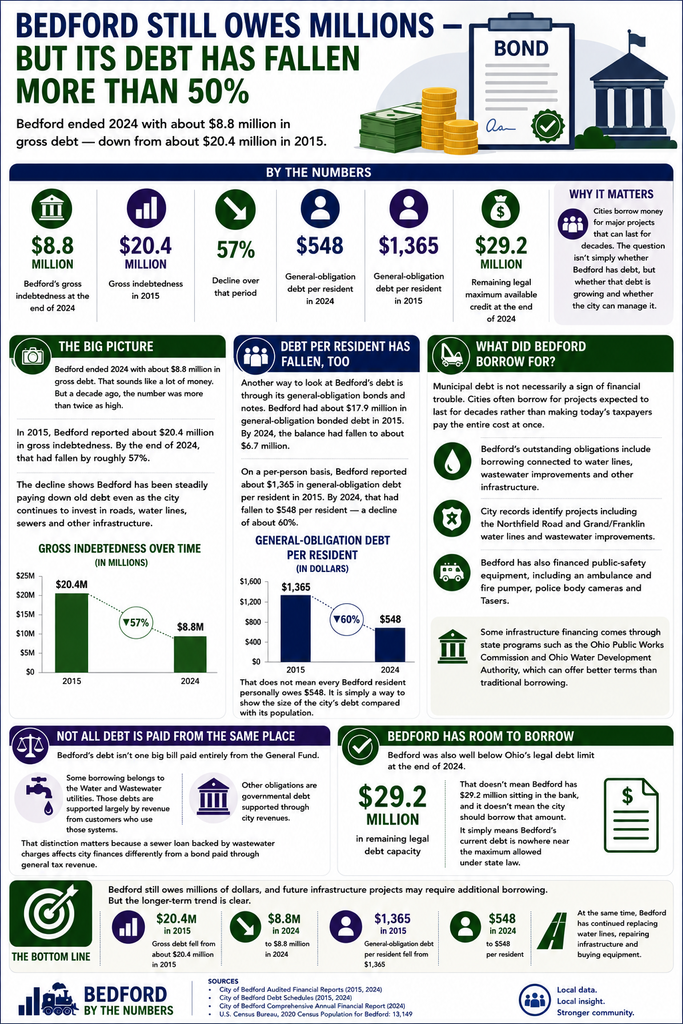

Bedford ended 2024 with about $8.8 million in gross debt — down from about $20.4 million in 2015.
By the numbers
$8.8 million — Bedford’s gross indebtedness at the end of 2024
$20.4 million — gross indebtedness in 2015
57% — decline over that period
$548 — general-obligation debt per resident in 2024
$1,365 — general-obligation debt per resident in 2015
$29.2 million — remaining legal maximum available credit at the end of 2024
Why it matters: Cities borrow money for major projects that can last for decades. The question isn’t simply whether Bedford has debt, but whether that debt is growing and whether the city can manage it.
The Big Picture: Bedford ended 2024 with about $8.8 million in gross debt. That sounds like a lot of money. But a decade ago, the number was more than twice as high.
In 2015, Bedford reported about $20.4 million in gross indebtedness. By the end of 2024, that had fallen by roughly 57%. The decline shows Bedford has been steadily paying down old debt even as the city continues to invest in roads, water lines, sewers and other infrastructure.
Debt per resident has fallen, too
Another way to look at Bedford’s debt is through its general-obligation bonds and notes. Bedford had about $17.9 million in general-obligation bonded debt in 2015. By 2024, the balance had fallen to about $6.7 million.
On a per-person basis, Bedford reported about $1,365 in general-obligation debt per resident in 2015. By 2024, that had fallen to $548 per resident — a decline of about 60%.
That does not mean every Bedford resident personally owes $548. It is simply a way to show the size of the city’s debt compared with its population.
What did Bedford borrow for?
Municipal debt is not necessarily a sign of financial trouble. Cities often borrow for projects expected to last for decades rather than making today’s taxpayers pay the entire cost at once. Bedford’s outstanding obligations include borrowing connected to water lines, wastewater improvements and other infrastructure.
City records identify projects including the Northfield Road and Grand/Franklin water lines and wastewater improvements. Bedford has also financed public-safety equipment, including an ambulance and fire pumper, police body cameras and Tasers.
Some infrastructure financing comes through state programs such as the Ohio Public Works Commission and Ohio Water Development Authority, which can offer better terms than traditional borrowing.
Not all debt is paid from the same place
Bedford’s debt isn’t one big bill paid entirely from the General Fund. Some borrowing belongs to the Water and Wastewater utilities. Those debts are supported largely by revenue from customers who use those systems. Other obligations are governmental debt supported through city revenues.
That distinction matters because a sewer loan backed by wastewater charges affects city finances differently from a bond paid through general tax revenue.
Bedford has room to borrow
Bedford was also well below Ohio’s legal debt limit at the end of 2024. The city reported about $29.2 million in remaining legal debt capacity. That doesn’t mean Bedford has $29.2 million sitting in the bank, and it doesn’t mean the city should borrow that amount. It simply means Bedford’s current debt is nowhere near the maximum allowed under state law.
The bottom line
Bedford still owes millions of dollars, and future infrastructure projects may require additional borrowing. But the longer-term trend is clear.
Gross debt fell from about $20.4 million in 2015 to $8.8 million in 2024. General-obligation debt per resident fell from $1,365 to $548. At the same time, Bedford has continued replacing water lines, repairing infrastructure and buying equipment.
So Bedford’s debt story isn’t simply about how much the city owes. It’s also about how much it has already paid off.